Sourcing restaurant pagers from China can be overwhelming. A wrong choice leads to chaos during busy shifts. Let's explore how to find a truly reliable partner for your business. To choose a restaurant pager manufacturer in China, evaluate their focus on signal reliability under pressure, their quality control processes beyond spec sheets, and their commitment to long-term support. Prioritize operational stability for your restaurant over the absolute lowest unit price from a supplier.  I've spoken with many international buyers over the years. A common theme I see is the intense focus on unit cost. While price is important, it's only one piece of the puzzle. The real cost of a pager system shows up during a busy Friday night dinner service, not on the initial invoice. A cheap pager that fails is far more expensive than a reliable one. So, let's break down how to look at this decision from a risk-control perspective, starting with the most common trap. ## Why is focusing only on the lowest price a mistake for restaurant pagers? That super-low quote on restaurant pagers looks tempting, right? But cheap components can lead to missed alerts and frustrated customers. Let's connect the price to real-world performance. Focusing only on the lowest price is a mistake because it overlooks critical performance factors for a restaurant. Signal reliability, anti-interference capability, and battery life are essential during peak hours. A cheap pager that fails costs more in lost business and reputation than a reliable one.
  In my conversations with overseas buyers, the first question is almost always about price. I understand why. Budgets are tight. But a restaurant is one of the most challenging environments for a wireless device. When we design a pager system, we aren't thinking about an empty room. We are thinking about your restaurant on a Saturday night. This is where the difference between a low-price pager and a reliable pager becomes clear. ### Signal Stability in a Crowded Room A pager's signal has to travel through people, walls, furniture, and other electronic noise from kitchen equipment and customer Wi-Fi.1 A manufacturer saves money by using cheaper radio components.2 These components might work fine in an open office test, but they can easily fail in a crowded restaurant.3 The result is a customer who never gets paged because the signal didn't reach them. ### Alert Reliability Under Pressure The whole point of a pager is to get someone's attention. A low-cost pager might have a weak vibration motor, a quiet beeper, or dim flashing lights. In a noisy and chaotic restaurant, these weak alerts are easily missed by customers.4 A reliable pager manufacturer invests in components that deliver strong, noticeable alerts every single time. ### The Hidden Cost of Charging Failures Pagers need to be ready for every shift. A cheap charging base often uses poor-quality charging pins or has an unstable power supply. This leads to pagers that don't charge properly or have a short battery life. A dead pager is useless and creates a bottleneck in your customer flow.5 | Feature on Spec Sheet | What Really Matters During Peak Hours | | :--- | :--- | | "Long Range" | Consistent signal through walls, people, and Wi-Fi interference. | | "Vibrate/Beep/Flash" | Strong vibration, audible beep, and bright lights that customers can't miss. | | "8-Hour Battery Life" | A reliable charging base that ensures every pager is ready for the next shift. | ## How can you verify a manufacturer's quality beyond product photos and spec sheets? All supplier websites show perfect pagers and great specs. But how can you be sure the bulk order will match the promise? Let's discuss how to uncover their real quality standards. Verify a manufacturer's quality by asking about their specific testing procedures. Inquire about their sample checks, aging tests for electronics, pre-shipment inspection protocols, and how they ensure batch-to-batch consistency. A serious partner will be transparent about their entire quality control process.
 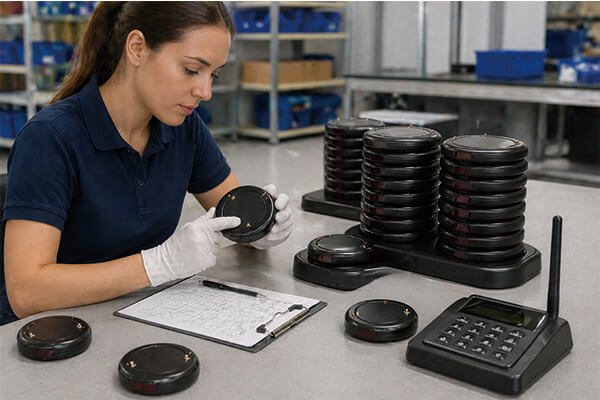 From a supplier’s perspective, a reliable manufacturer should be able to explain their quality process in detail. Product photos are marketing. A spec sheet is a promise. But the quality control process is the proof. When buyers ask us deep questions about our testing, we know they are serious about quality. You should do the same. ### Ask About the Sample Testing Process When you get a sample, don't just see if it turns on. Ask the manufacturer how they tested it before sending it to you. A good supplier should be able to describe their tests for key functions. For example, do they test signal range in a real-world environment with obstacles? Do they have a machine to test the durability of the buttons by pressing them thousands of times?6 Do they test its waterproof rating?7 Their answers will tell you a lot about their attention to detail. ### Inquire About Batch Consistency Getting one perfect sample is easy. Getting 1,000 perfect units in a bulk order is hard. This is where batch consistency becomes critical. Ask the manufacturer what steps they take to make sure every unit is the same. They should be able to talk about their incoming quality control for components like batteries and chips.8 They should also have standardized work instructions for their assembly line workers to prevent human error.9 A lack of clear answers here is a major red flag. ### Understand Their Pre-Shipment Inspection The final check before your order leaves the factory is the pre-shipment inspection. This is the last chance to catch any problems. A professional manufacturer will have a detailed checklist for this process.10 They should inspect every single unit for function (charging, paging, alerts) and appearance (scratches, defects). They should also check the packaging to ensure it can survive international shipping.11 Ask to see their inspection checklist. ## What defines a reliable long-term pager supplier for distributors and brands? Your first order went smoothly, and the price was great. But what happens next year when you need support or more stock? Let's explore what makes a supplier a true long-term partner. A reliable long-term supplier provides more than a low price. They guarantee supply consistency for future orders, maintain stable quality across batches, and offer responsive support for any issues that arise after deployment. Their goal is a partnership, not just a single transaction.
  For our clients who are distributors, chain restaurants, or e-commerce brands, the first order is just the beginning. They are not just buying a box of products. They are building a supply chain. Their brand reputation depends on our ability to deliver consistently over the long term. Price is a factor, but reliability is the foundation of the relationship. ### Consistency of Supply and Quality Imagine you build your brand around a specific pager model. A year later, you place a reorder, but the manufacturer has changed the design, the color is different, or worse, the performance is not the same. This creates a nightmare for your business. A dependable long-term partner has stable production processes. They will inform you of any changes well in advance and manage their product lifecycle professionally. You need to know that the pagers you order next year will be identical to the ones you sell today. ### Responsiveness to Problems No product is perfect. Even with the best quality control, issues can happen. What matters is how the manufacturer responds. Do they answer your email quickly? How do they handle warranty claims? Can they help you troubleshoot a problem with a customer overseas? A good partner stands behind their product. Before you place a large order, you should have a clear understanding of their after-sales support process. A supplier who disappears after they get paid is not a partner. ### A Partner in Your Business Growth The best supplier relationships we have are partnerships. We see ourselves as an extension of our client's team. This means we are flexible and ready to support their growth. For example, we offer OEM/ODM services to help them build their own brand. We can customize features or packaging to fit their specific market. A transactional supplier just wants to sell you what they have. A true partner wants to help you build what you need. This mindset is the key difference between a cheap supplier and a valuable one. ## Conclusion Choosing a restaurant pager manufacturer is a strategic decision. Look beyond the price tag. Focus on operational reliability, proven quality control, and dependable long-term support for your business's success.
A neutral RF engineering or standards source can support that indoor wireless signals are affected by obstacles, human bodies, multipath, and co-channel interference. ↩
A technical source on RF link budgets and receiver/transmitter specifications can substantiate why lower-performance radio components may lead to weaker reliability. ↩
Research or engineering guidance on indoor wireless testing can support the need to test devices in realistic environments rather than only open areas. ↩
Noise-level studies and human-factors alarm guidance can support the need for alerts that are strong enough to be noticed in high-noise settings. ↩
Hospitality or operations-management sources can support that failures in waiting-list communication tools can increase bottlenecks and affect customer flow. ↩
A standards or reliability-testing source can support the practice of testing buttons through repeated actuation cycles. ↩
IEC 60529/IP-code references can support how water-ingress protection ratings are defined and tested. ↩
ISO 9001 or quality-management guidance can support the importance of controlling externally supplied components before production. ↩
Quality-management or lean-manufacturing sources can support that standardized work reduces variation and helps prevent production errors. ↩
Inspection standards such as ISO 2859/AQL guidance can support structured pre-shipment inspection and defect-checking practices. ↩
Packaging standards such as ISTA or ASTM D4169 can support the need to verify packaging against vibration, drops, compression, and other shipping stresses. ↩