Complete Guide to Restaurant Table Tracking Systems: A Technical Procurement Perspective
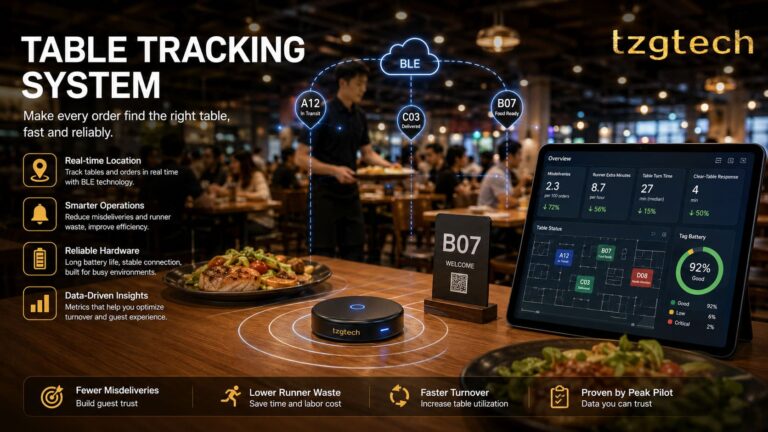
Restaurant table tracking systems may look simple, but they play a critical role in real restaurant operations. During peak hours, an unstable system can lead to lost orders, incorrect deliveries, and degraded customer service. For B2B buyers, distributors, and restaurant brands, evaluating these systems requires looking beyond surface-level aesthetics to focus on signal integrity, mechanical reliability, and standardized quality control.
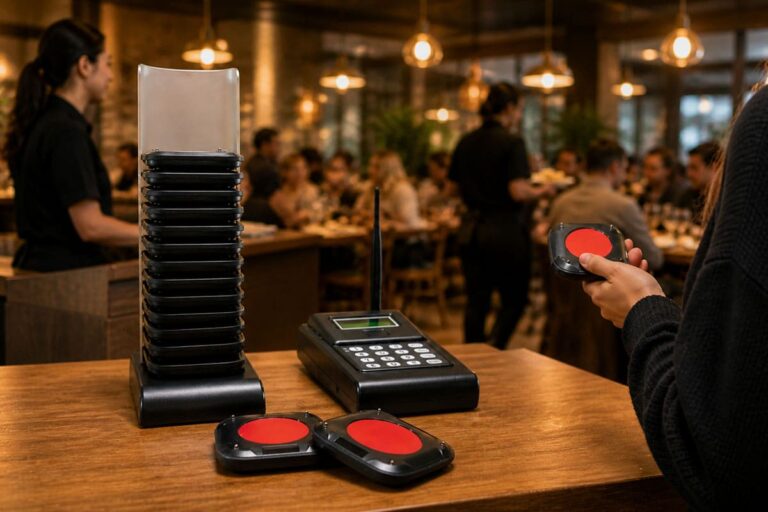
A restaurant table tracking system helps connect dine-in orders with seating locations. Reliable procurement relies on evaluating table identification accuracy, signal stability under RF interference, charging connector integrity, and consistent batch quality managed through standardized sampling.
!(https://www.tzgtech.com/wp-content/uploads/2026/04/1-1.jpg "Restaurant Table Tracking System")
Understanding the Technical Challenges
Many buyers first treat table tracking systems as simple consumer electronics, focusing on price and design. However, a restaurant is a demanding RF (Radio Frequency) and mechanical environment. The real value is realized only when the system maintains 100% operational reliability during peak dinner rushes.
1. Signal Stability: Managing Multipath Interference
In a dining room, signals must navigate through people, metallic kitchen equipment, and Wi-Fi networks. A basic device may work in an empty room but fail when the environment changes.
- The Engineering Reality: Radio signals in enclosed spaces suffer from Multipath Interference, where signals bounce off objects and arrive at the receiver out of phase, causing "dead spots."
- Procurement Insight: Professional manufacturers perform system-level optimization to mitigate fading. When evaluating a system, ask how the design handles signal propagation in obstructed environments rather than simply asking for "range in open space."
2. Charging Reliability: Contact Resistance
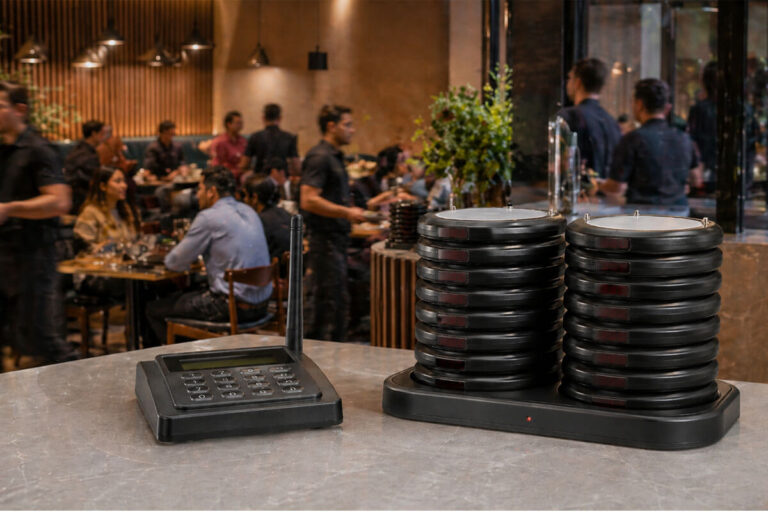
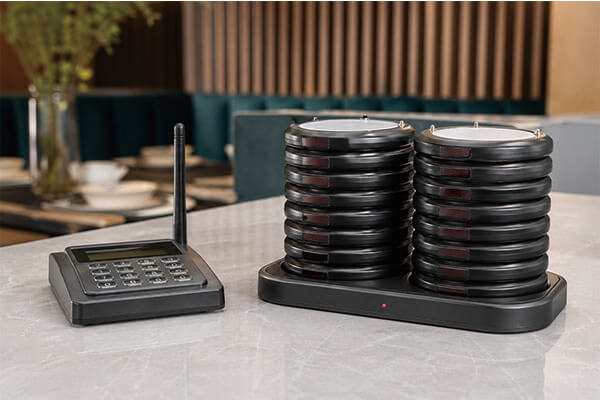
The charging base is often the first point of failure. The connection relies on pogo pin connectors, which must maintain high conductivity.
- The Engineering Reality: The performance of these pins is measured by Contact Resistance. High contact resistance—caused by oxidation or poor spring pressure—leads to voltage drops, signal garbling, and charging failure.
- Procurement Insight: Quality connectors should maintain low milliohm (mΩ) resistance to ensure devices are always ready for service. Ensure your supplier specifies the material (e.g., gold-plated contacts) to prevent oxidation in high-humidity restaurant environments.
How to Verify Quality Standards
All suppliers show perfect photos, but professional buyers look at the verification process.
Batch Consistency via AQL Standards
To ensure that a bulk order of 1,000 units is as reliable as a sample, manufacturers must utilize statistical quality control.
- The Standard: Professional production lines use ISO 2859-1 (Acceptance Quality Limit - AQL) procedures.
- Procurement Insight: Instead of asking "Is it good quality?", ask: "What is your AQL level for major and minor defects?" A reliable partner will provide their inspection checklist and define their tolerance levels mathematically.
Reliability Testing: Environmental Stress Screening (ESS)
Electronics can pass a functional test but fail after three months of daily use in a busy kitchen.
- The Standard: Manufacturers should perform Environmental Stress Screening (ESS), which uses thermal cycling or controlled vibration to expose latent manufacturing defects before shipping.
- Procurement Insight: Ask if the manufacturer performs "burn-in" or aging tests on charging bases and batteries. This is the difference between a prototype and a product built for commercial longevity.
Key Performance Indicators (KPIs) for Evaluation
When testing samples, do not just check if they turn on. Use this checklist for a technical assessment:
| Feature | Engineering Requirement |
|---|---|
| Signal Integrity | Consistent performance despite physical obstructions (mitigating multipath fading). |
| Charging Contact | Low contact resistance (<50 mΩ) to prevent charging failures during shifts. |
| Batch Quality | Adherence to ISO 2859-1 AQL standards for every production run. |
| Durability | Housing strength and component assembly capable of withstanding daily sanitization. |
| Documentation | Availability of technical manuals and clear setup/troubleshooting guides. |
Conclusion
Choosing a restaurant table tracking system is a strategic supply chain decision. By shifting the conversation from "price" to "engineering specifications"—such as signal multipath management, contact resistance thresholds, and ISO-standardized QC processes—you move from buying a consumable to investing in operational infrastructure. A reliable partner will be transparent about these technical details, proving that their product is built for the rigors of commercial service.